Description

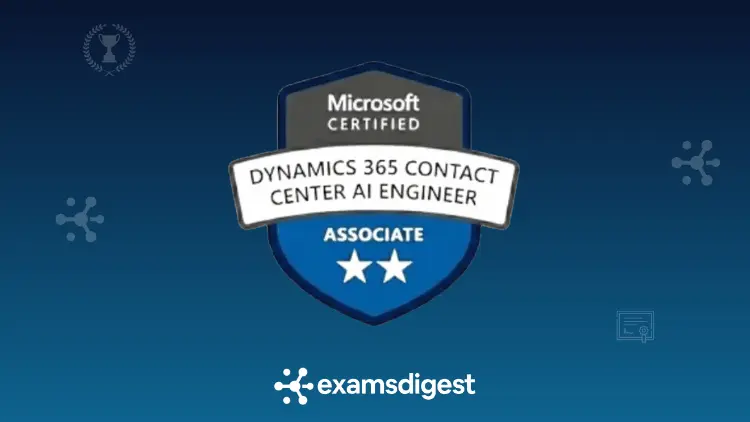
For learners studying for Microsoft Certified: Dynamics 365 Contact Center AI Engineer Associate
What you'll learn
Practice pack content
Domain 1 - Deploy Dynamics 365 Contact Center
Domain 2 – Implement channels
Domain 3 – Configure agents and AI capabilities
Domain 4 – Configure work distribution
Domain 5 – Configure the Dynamics 365 Contact Center representative experience
Domain 6 – Manage analytics for the Dynamics 365 Contact Center
Final Exam Simulators
Exam Study Guide
Interactive Flashcards
Try 3 Dynamics 365 Contact Center AI Engineer AB-250 practice questions
Choose an answer, explore the explanation, and see why the other options are less suitable. Three short scenarios. No sign-in required.
Implement channelsConfigure chat and digital channels · Pre-chat surveys
1. Collect customer details before the chat
A retailer has embedded Dynamics 365 Contact Center chat on its support website. Before a conversation starts, visitors must select an issue category from a drop-down and enter an order number; both responses must be available as conversation context. Which configuration best meets this requirement?
- Create chat quick replies for issue categories and have the representative ask for the order number after accepting the chat.
- Enable a postconversation survey and add mandatory issue-category and order-number questions to the survey.
- Enable a preconversation survey on the chat channel with required option-set and single-line questions.
- Add an agent script that opens the issue-category and order-number fields when the representative starts the session.
Answer and full explanation
Correct answer: C — Enable required preconversation survey questions on the chat channel.
Why C is correct
A preconversation survey gathers information when a visitor opens the chat widget, before the service conversation begins. An option-set question presents the support categories as a selection, while a single-line question captures the order number. Marking both questions as required prevents submission without those answers. Dynamics 365 Contact Center creates corresponding context variables for the survey questions, making the responses available to the conversation workflow. Configure these settings in the chat workstream’s channel settings and verify the resulting conversation context.
Why the other options are less suitable
- A — Quick replies after chat acceptance: Quick replies can help send common messages during a conversation. They do not require the visitor to submit structured information before the conversation starts.
- B — Postconversation survey: A postconversation survey collects feedback after an interaction. It cannot supply the required issue category and order number before the initial chat begins.
- D — Representative session script: An agent script can guide a representative after a conversation is assigned. It does not require the customer to answer the questions in the chat widget before the conversation starts.
Key takeaway: Preconversation surveys capture required chat inputs and expose the responses through context variables.
Read two more sample questions
Configure agents and AI capabilitiesConfigure voice agents · Generative AI and classic orchestration
2. Choose a natural, real-time voice experience
A travel company wants a Copilot Studio voice agent for Dynamics 365 Contact Center. Callers should be able to speak naturally, ask open-ended follow-up questions with minimal delay, and transfer complex requests to a human representative. Which design best matches the required conversational experience?
- Use a real-time voice agent with generative orchestration and configure the required call-transfer path.
- Use a basic voice agent with a fixed DTMF-only menu and require callers to choose numbered options.
- Enable call transcription and after-call summaries without deploying a conversational voice agent.
- Use an outbound dialer campaign with prerecorded announcements and no interactive agent conversation.
Answer and full explanation
Correct answer: A — Use a real-time voice agent with generative orchestration and call transfer.
Why A is correct
Copilot Studio real-time voice agents use a speech-to-speech model to support low-latency, natural conversations. Generative orchestration is designed for fluid exchanges rather than a fixed sequence of menu prompts. The agent can handle spoken requests and follow-up questions while using configured knowledge or tools as appropriate. Voice agents also support call transfer, so complex issues can be handed to a human representative. The design should include tested escalation conditions and an authorized transfer destination.
Why the other options are less suitable
- B — Fixed DTMF-only menu: A menu can be appropriate when callers need a small number of predictable choices. Requiring numbered input would not deliver the requested open-ended, natural spoken conversation.
- C — Transcription and summaries only: Transcription and summaries provide records and assistance around calls. Without a conversational voice agent, they do not answer live follow-up questions or carry out the self-service dialogue.
- D — Outbound prerecorded campaign: An outbound campaign is designed to initiate contact at scale. Prerecorded announcements without an interactive voice agent do not meet the incoming conversational self-service requirement.
Key takeaway: Choose real-time voice agents for low-latency generative dialogue, and explicitly configure human escalation.
Configure work distributionConfigure basic and unified routing · Skills-based routing
3. Route multilingual support chats by skill
A warranty support team receives English and French chats for several product lines. Each incoming chat must go only to a representative who meets both the required language and product-support skill levels, while also being available and within capacity. The team uses unified routing with built-in queue assignment. Which configuration should it choose?
- Use queue priority and round-robin assignment without attaching language or product skills to the work item.
- Enable preferred-representative routing based on previous interactions, without enforcing skill requirements.
- Select Closest Match in the workstream but leave the work-classification skill attachment rules unconfigured.
- Attach required skills through classification rules and enable Exact Match with a built-in queue assignment method.
Answer and full explanation
Correct answer: D — Attach required skills and use Exact Match with a built-in assignment method.
Why D is correct
Unified routing first classifies work items and can attach language, product, and required proficiency information. Exact Match selects representatives who meet all of the attached skill requirements at the required levels. With a supported built-in queue assignment method, representative presence and capacity are also considered. This prevents the system from assigning a chat to someone who lacks a required skill simply to reduce waiting time. The configuration requires both skill classification and the matching algorithm; selecting the algorithm alone is insufficient.
Why the other options are less suitable
- A — Priority and round robin alone: Queue priority and round robin can organize and spread work across representatives. Without attached skill requirements, those settings cannot guarantee both the language and product expertise.
- B — Previous-representative routing: Preferred-representative routing can preserve continuity with a returning customer. History alone does not establish that the representative meets the current language and warranty skill requirements.
- C — Closest Match without skill rules: Closest Match can favor representatives with similar skills when an exact match is unavailable. Without rules that attach required skills to the chat, it lacks the information needed to enforce the requested skill criteria.
Key takeaway: Attach skills during classification and use Exact Match when every required skill must be satisfied.
Preview complete
You have tried all three samples
Review the explanations or try the samples again. This short preview covers only a small part of the exam objectives.
Your sample score resets when this page reloads.
Your practice pack includes
More ways to make each study session count
Focus on a topic, practise under a time limit, or return to the supporting resources before your next attempt.
Domain-based practice
Timed practice sets
Study guide
Flashcards
Requirements
- Microsoft describes AB-250 candidates as contact center engineers or solutions professionals familiar with CCaaS implementation, voice and digital channels, representative roles, routing, and AI-assisted support.
- Use Microsoft Learn and authorized sandbox exercises to strengthen weak areas in Copilot Studio voice agents, routing rules, workforce forecasting, and Power BI reporting; practical labs are not implied to be included.
- You need an internet-connected device, a current web browser, and an ExamsDigest account to use this online practice product; offline access and a native mobile app are not implied.
Know the exam you’re studying for
These details describe Microsoft's official AB-250: Transforming Contact Center Experiences with AI in Dynamics 365 exam.
What our students say
"The AB-250 practice exams helped me understand some of the more confusing topics, especially unified routing and contact center configuration. The explanations were clear and showed me exactly what I needed to review before exam day."
James Peterson
✓ Verified Review
"I used ExamsDigest alongside Microsoft Learn while studying for AB-250. The questions covered Copilot Studio, voice agents, and real-world contact center scenarios. It was a great way to find my weak areas and check my understanding."
Sarah Mitchell
✓ Verified Review
"I tried a few other practice tests before finding ExamsDigest. What stood out was the quality of the explanations. Instead of just showing the correct answer, they helped me understand why the other options were wrong. That made a big difference in how I studied."
Daniel Brooks
✓ Verified Review
Your questions, answered.
Which Microsoft exam does this practice target?
This practice targets Exam AB-250: Transforming Contact Center Experiences with AI in Dynamics 365, associated with Microsoft Certified: Dynamics 365 Contact Center AI Engineer Associate. Microsoft lists this exam for scheduling after originally introducing it in beta. Before purchasing, compare the product’s stated scope with the current AB-250 study guide, especially its coverage of channels, Copilot Studio agents, routing, and analytics. These are original practice scenarios, not official examination questions.
Who should use these AB-250 practice questions?
AB-250 is intended for intermediate-level contact center engineers and solution professionals who implement and support AI-powered customer service. Microsoft recommends familiarity with CCaaS, digital and voice channels, representative and supervisor roles, routing, and AI-assisted service. Experience with Power Platform, Copilot Studio, Teams, Power BI, and Microsoft Foundry also helps. The questions assume you can select and explain configurations for real service-delivery requirements.
How should I combine practice questions with hands-on study?
Use Microsoft’s AB-250 study guide to prioritize objectives, then explore the relevant settings in an authorized Dynamics 365 Contact Center or Copilot Studio environment. For example, configure a preconversation survey, compare real-time and basic voice agents, and test exact skills-based routing with representative availability. Use documentation to verify the observed behavior before retrying similar questions. Suggested exercises are not a claim that the practice product includes labs.
What should I do when my practice answer is incorrect?
Identify the decisive constraint in the scenario, such as capturing data before chat, minimizing voice-response latency, or enforcing every required representative skill. Read both the correct-answer explanation and the alternative rationales to understand what each configuration actually does. Revisit the mapped Microsoft Learn topic and test the setting when possible. Use repeated weak areas to direct study rather than treating a practice percentage as an exam pass prediction.
What are the AB-250 examination format and time limit?
Microsoft lists 120 minutes for the official AB-250 assessment and says the proctored examination may contain interactive components. Microsoft’s technical certification exams can use a variety of question formats; no fixed AB-250 question count or guaranteed lab component is published. The three sample questions on this page are single-answer multiple choice, so they demonstrate scenario reasoning but do not replicate every possible official exam task or interface feature.
Does purchasing practice register me for AB-250 or award certification?
No. Working through an ExamsDigest practice product does not register you for a Microsoft examination or award a Microsoft credential. To earn Microsoft Certified: Dynamics 365 Contact Center AI Engineer Associate, you need to meet Microsoft’s official requirements, including passing AB-250. Exam scheduling and any voucher arrangements must be checked separately; do not assume a voucher is part of this practice pack. The credential is also subject to Microsoft’s renewal policies after you earn it.
30-day conditional refund policy
Eligible requests must be made within 30 calendar days, with no more than 20% of any included simulator completed. The purchase must not already be refunded or under a payment dispute or chargeback. Other provisions apply; mandatory consumer rights remain unaffected.
Useful links for your preparation