Description

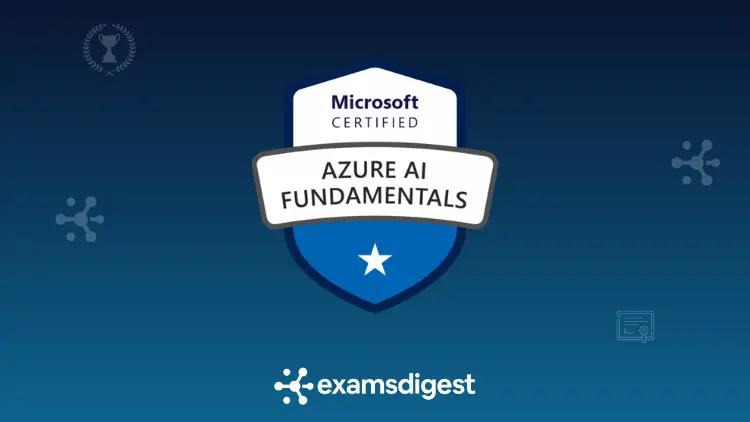
For learners studying for Microsoft Certified: Azure AI Fundamentals
What you'll learn
Practice pack content
Domain 1 - Identify AI concepts and capabilities
Domain 2 – Implement AI solutions by using Microsoft Foundry
Final Exam Simulators
Exam Study Guide
Interactive Flashcards
Try 3 Azure AI Fundamentals AI-901 practice questions
Choose an answer, explore the explanation, and see why the other options are less suitable. Three short scenarios. No sign-in required.
Identify AI concepts and capabilitiesTopic · Describe principles of responsible AI
1. Making AI recommendations understandable
A university uses an AI system to suggest training courses to employees. Staff can request human review, but they cannot tell whether a recommendation came from AI or what the system’s limitations are. Which responsible AI principle most directly addresses explaining the system’s role and limitations?
- Fairness, by checking that employees with similar needs receive equitable recommendations.
- Reliability and safety, by testing how consistently the system performs its intended task.
- Privacy and security, by restricting access to employee records used by the system.
- Transparency, by disclosing AI involvement and explaining the system’s purpose and limits.
Answer and full explanation
Correct answer: D — Transparency through disclosure and understandable information about the system.
Why D is correct
Transparency means people should be able to understand that AI is involved and what the system is intended to do. In this scenario, employees cannot identify the origin of the recommendations or the limitations of the tool. Clear disclosure and an explanation of its role directly address that missing information. Human review is valuable, but its availability does not itself tell employees how the initial recommendation was produced. The organization should also communicate the system’s limitations so people can interpret its suggestions appropriately.
Why the other options are less suitable
- A — Fairness: Fairness concerns whether outcomes treat people and groups equitably. Testing the distribution of recommendations matters, but it does not provide the missing disclosure about AI involvement.
- B — Reliability and safety: These principles concern dependable behavior and the prevention of harmful failures. Testing performance does not directly explain the system’s role or limitations to employees.
- C — Privacy and security: Protecting employee records and controlling access are important requirements. They do not by themselves tell staff that AI is being used or explain how to interpret recommendations.
Key takeaway: Transparency helps people recognize AI involvement, understand its purpose and appreciate its limitations.
Read two more sample questions
Implement AI solutions by using Microsoft FoundryTopic · Implement generative AI apps and agents by using Foundry
2. Shared instructions for every chat
A developer deploys a chat model through Microsoft Foundry for product-support conversations. Every session must use a polite tone, stay within a defined support scope, and say when a question cannot be answered, while each customer supplies a different question. Which message role is the appropriate place for those shared instructions?
- A user message, so each customer supplies the shared instructions along with a question.
- A system message, so the application supplies behavioral instructions for every conversation.
- A tool message, so a connector supplies the shared rules when it returns retrieved data.
- An assistant message, so a previous model answer defines the rules for new conversations.
Answer and full explanation
Correct answer: B — A system message for application-wide response guidance.
Why B is correct
A system message provides instructions and context that guide how a chat model responds. It can establish the assistant’s role, tone, scope, and expected behavior across customer conversations. Those requirements apply to the application rather than to any one customer’s request. Each customer can then send a separate user message containing the specific question. The developer should still validate model responses and use other appropriate safety controls, because a system message is not an infallible enforcement mechanism.
Why the other options are less suitable
- A — User message: A user message normally carries the customer’s particular request. Making every customer repeat application-wide rules would not reliably establish consistent behavior across sessions.
- C — Tool message: A tool message normally returns data or the result of an external action. It is not the intended place to establish the model’s standing role and response guidance.
- D — Assistant message: An assistant message represents output previously generated by the model. A prior answer is not a reliable substitute for the application’s explicit system-level instructions.
Key takeaway: Keep persistent application instructions separate from the questions submitted by individual users.
Implement AI solutions by using Microsoft FoundryTopic · Implement AI solutions for information extraction by using Foundry
3. Extracting fields from varied supplier documents
A procurement team receives scanned invoices and digital purchase forms from several suppliers. It needs a Microsoft Foundry capability that can extract names, dates, and line items into consistent structured fields for downstream processing. Which option most directly addresses this information-extraction requirement?
- Azure Content Understanding in Foundry Tools, configured with an appropriate extraction schema.
- Azure Speech in Foundry Tools, configured to convert spoken audio into written text.
- Azure AI Search, configured to find indexed files that contain particular search terms.
- An image-generation model, configured to create realistic examples of supplier documents.
Answer and full explanation
Correct answer: A — Azure Content Understanding with schema-based field extraction.
Why A is correct
Azure Content Understanding in Foundry Tools can process documents and images and produce structured information. An analyzer can use a defined field schema to extract items such as supplier names, dates, and invoice line details. That output is suitable for later validation and integration into a processing workflow. The scenario requires obtaining field values from incoming source documents, rather than searching for documents or generating new ones. The team should still verify uncertain extracted values and use appropriate access and data-handling controls.
Why the other options are less suitable
- B — Azure Speech: Azure Speech is suited to tasks such as converting spoken audio to text. The source material here consists of scanned and digital business documents, not spoken input.
- C — Azure AI Search: Azure AI Search helps index and retrieve relevant content. Retrieval can support another workflow, but it does not directly replace schema-based extraction of invoice fields from each incoming document.
- D — Image generation: An image-generation model creates visual content from prompts. Producing sample documents would not extract the actual supplier details from the documents the team receives.
Key takeaway: Use Content Understanding when the goal is structured information extraction from unstructured documents.
Preview complete
You have tried all three samples
Review the explanations or try the samples again. This short preview covers only a small part of the exam objectives.
Your sample score resets when this page reloads.
Your practice pack includes
More ways to make each study session count
Focus on a topic, practise under a time limit, or return to the supporting resources before your next attempt.
Domain-based practice
Timed practice sets
Study guide
Flashcards
Requirements
- Microsoft expects conceptual knowledge of Azure AI, familiarity with Azure resources, and knowledge of Python syntax and programming techniques. REST APIs, SDKs and CLIs are also relevant to the AI-901 objectives.
- Combine question practice with Microsoft Learn and your own authorized Foundry exercises, such as testing model prompts or extracting fields from sample documents. No hosted labs or Azure subscriptions are implied.
- You will need an internet-connected device, a current web browser and an ExamsDigest account to access this online practice product and review your study work.
Know the exam you’re studying for
These details describe Microsoft’s official Microsoft Azure AI Fundamentals (AI-901) exam exam.
What our students say
“I was finding the Microsoft Foundry topics a bit confusing, especially system prompts and how AI models are used in different scenarios. The ExamsDigest practice questions helped me understand those concepts much better, and the explanations were genuinely useful.”
Ryan Mitchell
✓ Verified Review
“The practice exams helped me identify which AI-901 topics I needed to study again. I particularly liked the questions about responsible AI and generative AI because they made me think about real situations instead of just memorizing definitions.”
Samantha Brooks
✓ Verified Review
“I had already worked through Microsoft Learn, but I wanted to check how well I understood the material. ExamsDigest helped me spot gaps in my knowledge, especially around Microsoft Foundry and AI information extraction. The explanations made reviewing those topics much easier.”
Christopher Hayes
✓ Verified Review
Your questions, answered.
Which Azure AI Fundamentals exam does this practice target?
This practice targets AI-901: Microsoft Azure AI Fundamentals, using the English skills outline effective April 15, 2026. The previous AI-900 exam was retired on June 30, 2026, so its older objectives should not be substituted for this product. Before purchasing, compare the listed practice topics and included materials with the official AI-901 guide and your intended exam language.
Is AI-901 suitable for beginners, and do I need Python?
AI-901 is intended for people beginning their careers in AI solution development, but Microsoft expects some technical background. Familiarity with Azure resources, Python syntax and programming techniques will help. The objectives also reference REST APIs, SDKs and CLIs. You can use practice questions while learning these foundations, but question practice should not replace studying the technical concepts and workflows that the examination covers.
How should I combine AI-901 questions with practical study?
Use questions alongside Microsoft Learn and authorized exercises in Microsoft Foundry. For example, compare system and user prompts, explore model deployment options, examine a simple Python chat client, or test document field extraction with Azure Content Understanding. Focus on understanding the purpose of each component. These suggested activities do not imply that Microsoft licenses, cloud credits or hosted hands-on environments are included in the practice pack.
What should I do after an incorrect answer?
Identify the requirement you missed and compare your reasoning with each explanation. For example, distinguish transparency from fairness, application instructions from user messages, or document extraction from search and retrieval. Revisit the corresponding Microsoft Learn topic and then try another scenario. Understanding why the other options are less suitable is more useful than memorizing an answer letter. Practice scores do not guarantee an official examination result.
Does this preview reproduce the official AI-901 exam format?
No. This preview provides three questions with four choices and one correct answer each. Microsoft does not disclose the exact question-type mix before the examination, and its exam sandbox demonstrates a variety of possible interactions. AI-901 objectives also cover practical implementation concepts using Foundry, Python and SDKs. Check the paid pack’s stated formats separately rather than assuming that the preview reproduces every official task type.
Does completing this practice earn Microsoft Azure AI Fundamentals?
No. Purchasing or completing independent practice questions does not award Microsoft Certified: Azure AI Fundamentals. The certification currently lists AI-901 as its required examination. Earning the credential requires passing the official exam and satisfying Microsoft’s applicable candidate requirements. Practice access and official registration are separate activities. Check the product’s stated commercial terms for any voucher arrangements rather than assuming an exam booking is included.
30-day conditional refund policy
Eligible requests must be made within 30 calendar days, with no more than 20% of any included simulator completed. The purchase must not already be refunded or under a payment dispute or chargeback. Other provisions apply; mandatory consumer rights remain unaffected.
Useful links for your preparation